

Using the Illustrious 18 as a Defensive Tool
Using the Illustrious 18 as a Defensive Tool
By Bill Zender and Andrew Uyal
What are Decision Indices?
Mathematician and Blackjack advantage player, Donald Schlesinger released a list of card counting strategy deviations known as the “Illustrious 18” in September 1986, published in the Blackjack Forum in an article titled “Attacking the Shoe.” Schlesinger’s motivation was to provide the Blackjack card counting community with an alternative to memorizing 200 plus strategy deviations commonly used by professional card counters to attack the single deck game. Schlesinger’s analysis identified which decisions in a multiple deck Blackjack game were the most important based on frequency of occurrence and monetary importance. His plan was to efficiently reduce the number of necessary strategy deviations from Basic Strategy and make it easier for the professional to remember and use effectively.
To further explain what the Illustrious 18 represents, one must consider why deviation in hand strategy, i.e., when to hit, stand, double down, split and insure (and in some cases when to surrender) from Basic Strategy is necessary. Please understand the concept for using Basic Strategy is based on a full deck (or number of decks) composition. Once the deck(s) of cards start to deplete as the hands are dealt and the composition of the cards change, in some situations the use of Basic Strategy could be incorrect.
For instance, the mathematical house advantage (H/A%) of a six-deck game utilizing the common rules of hitting soft 17, double after splitting and 3:2 blackjack payoff is 0.61563% or 0.62%, based on the Wizard of Odds Blackjack Edge Calculator. However, using the same decks and rules, if the game is dealt 75% into the six decks (4.5 deck penetration), the actual H/A% increases slightly to 0.63873% or 0.64%. While the difference is not significant, it does illustrate that the deeper one deals into the given number of decks, Basic Strategy is not always correct. Subsequently, an alternative strategy could be employed to lessen the effect, and in some situations, slightly reverse the house’s mathematical advantage.
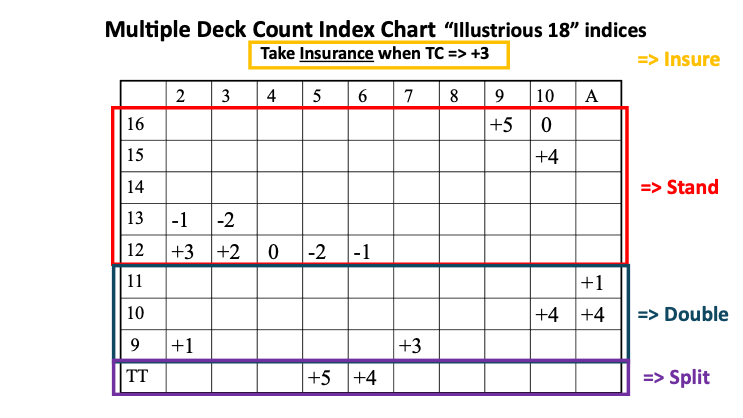
Through rigorous computations, Schlesinger reduced the 200+ strategy decisions down to 18 decisions that represented 90% of all hand deviations the professional counter would need to make [Blackjack Attack, 3rd Edition, p 62, Table 5-1]. Note: Schlesinger recommends these “Hi/Lo” true count deviation points, also known as “indices”, to be used in multiple deck games (two or more decks). The full Illustrious 18 indices are shown in a simple chart titled “Multiple Deck Count Index Chart, “Illustrious 18” indices.
The question I often receive from casino executives is how someone interprets the indices. As one can see the Illustrious 18 indices are broken into four decision groups, Insure, Stand, Double, and Split. Each index number represents the true count at which the counting player pivoits away from Basic Strategy to instead use one of these 4 strategy commands. For example, reading the chart the same way one would read a Basic Strategy chart (player’s hand on the left & dealer’s up card on top), the decision of player 15 versus a dealer’s T (any ten value card) is +4. This reads as “at +4 equal to or greater than the player Stands”. Note: Anything in the colored box, in this case Red, is to Stand. Also, understand that a True Count of +4 means that there is a surplus of four tens/aces for every deck of cards. At an even count there is no surplus of tens/aces and Basic Strategy dictate it is mathematically better for the player to “Hit” a hand of 15 v T. However, when the True Count climbs to +4 or great, it is mathematically better to Stand because of the surplus of tens.
One will notice that any index number inside the Blue colored box instructs the counter to Double Down when the True Count index number is reached, while the two indices inside the purple box, when reached, will instruct the counter to Split. Most casino executives believe that anyone who Splits ten value cards is an “uneducated”Blackjack player. This is the case when the player is wagering in lower limits, but is just the opposite when the player is wagering a significant amount of money. Important: In most situations, the Blackjack player who is wagering a significant amount of money, who Splits ten value cards, knows more about the game of Blackjack than the people watching him.
The most important indices used by the professional card counter is to determine when to take Insurance. Where Basic Strategy instructs the player to never take insurance, at a True Count of +3 equal to or greater than, the counter must insure his hand(s) since the surplus of tens makes insurance a profitable wager.
Using Indices for Defensive Purposes: Surveillance
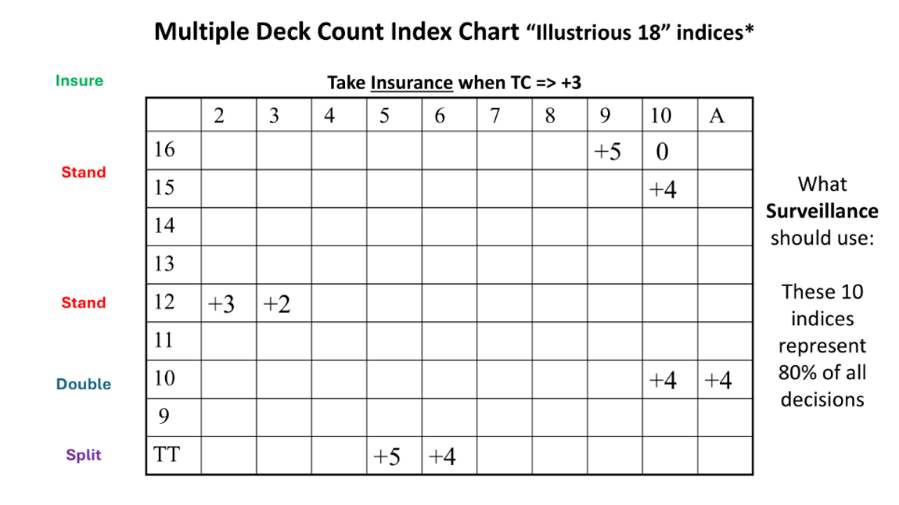
The Illustrious 18 are used by all professional card counters, but is there any modification that represents the more obvious deviations that can be used by the game protection professional? Yes there is. I have taught card counting to a number of casino executives over the years and I have found that these deviation indices can be paired down to 10 decisions for use by surveillance. These indices are shown in the previous modify chart.
For game protection professionals in Surveillance, I have removed all negative value indices as well as several of the lower value ones, and reduced the deviations to 10. Not only is it difficult to work with negative indices, they also are only used when the card counter is wagering minimum bets. These 10 indices still represent 80% of all decisions the professional counter will use, and provide the surveillance operater with a more effective detection tool. Please note that taking Insurance and Spliting tens is still on the list. It is also recommended that Surveillance have a copy of these modified indices available for their operators to review. Utilizing the entire 18 indices or an entire list of all decision indices (200+) is not worth the time or effort, or the frustration when attempting to spot less than valuable situations.
Remember: Surveillance should use this index number information to help identify potential card counting threat and to support confrimation obtain through bet spread to True Count analysis. They should NOT be used for card counting confirmation on their own merit.
Using Indices for Defensive Purposes: Blackjack Floor
If the number of usable indices can be reduce for surveillance, what about for the Blackjack floor supervisor? Over the years of training and also managing floor operations, I have found that it is all but impossible to expect the floor supervisors to watch for all 18 strategy deviations. The floor supervisor’s main tasks are to rate the customer and manage their sections, and do not have time to focus on card counting. However, I do require my floor supervisors to understand the professional counter’s bet spread requirements and a few key deviations. For the floor supervisors I have reduced the Illustious 18 indices down to only three decisions.
- Take Insurance at +3 equal to or greater than
- Stand on 16 v T at 0 equal to or greater than
- Stand on 15 v T at +4 equal to or greater than
These three decisions encompass 60% of the decisions the professional counter needs to make. I can even make it easier for the floor supervisor by framing these decisions around the level of wagering by the suspected player:
If the player is observed wagering at or near his or hers MINIMUM amount of the bet spread, the player will NOT taking Insurance and HIT 16 v T and 15 vT.
If the player is observed wagering at or near his or hers MAXIMUM amount of the bet spread, the player will be seen TAKING Insurance and STANDING on 16 v T and 15 vT.
Final Thoughts on The Illustrious 18
Donald Schlesinger developed the Illustious 18 to assist the professional level card counter in reducing the various Basic Strategy deviations to the most important and most usable indices. This gave the professional counter less decisions to remember and reduced stragey mistakes. These 18 decisions represent the top 90% of decisions the counter needs to make. Note: The values of these 18 indices are based on utilizing the “Hi/Lo” count system and True Count conversion.
The need for deviating away from Basic Strategy has to do with the changes in deck composition that will occasionally render Basic Strategy incorrect for the situation. In addition, the indices allow the counter to take advantage of ten value card “rich” situations by advising when to Double Down, Split and when to take Insurance profitably.
For defensive purposes, the surveillance professional does not need to know all 18 decisions and can easily and correctly rely on 10 key indices. These indices will provide the surveillance operator with 80% of the most important deviation decisions. In addition, the surveillance operator is in a position where they can refer to the modified indices chart to verify any suspcious strategy decision.
Floor supervisors do not have the time to focus on players suspected of counting cards. However, the floor still needs to know three key deviations from Basic Strategy, when to take Insurance and when to stand on 15 & 16 versus T. Along with having an understanding of the bet spread needed by the professional counter, floor personnel can identify and inform Surveillance of likely suspects.
-30-