
Steps to Determining an Accurate Mathematical House Advantage for Blackjack
By Bill Zender and Andrew Uyal
Introduction
Based on experience as a gaming consultant there is evidence that points to the fact that a majority of player tracking systems in North American casino do not operate with an accurate house advantage percentage (H/A) for calculating Blackjack theoretical win (T-win). In most cases the mathematical advantage input into the system is the program provider’s “default” percentage, or inhouse marketing’s estimate based on what they feel the customer wants. The following article will illustrate the steps you need to take to pull together an accurate mathematical advantage for all your standard Blackjack games. The three elements that we will take into consideration are Step (1) the effect of your rules and number of decks used based on the baseline use of basic strategy. Step (2) the effect that the players have over the game based on how well, or not so well, they make hand strategy decisions during normal play. And (3), any effect from the wagering of Blackjack side bets.
Determining Basic House Advantage
In this example we will use the most common Blackjack game which is the shoe dealt six-deck game. The rules used are blackjacks pay 3 to 2, hit soft 17 (h17), double on any two cards, and double after splitting (DAS). This seems to be the more standard Blackjack game dealt in North America at this present time. It does not matter how deep we deal into the decks, but the example used will include a shuffle point somewhere between 66% to 83% of the six-decks of cards.
Instead of going through a list of rules and their mathematical effect on the game, we will use the Wizard of Odds website and Michael Shackleford’s page containing the Blackjack House Edge Calculator: wizardofodds.com/games/blackjack/calculator/. You need to go to this page to follow along with the first step of this process. Once you are on that page, go through Wizards check list and check all the buttons that apply to the previously described six-deck game.
These buttons are:
- For the number of decks click the “6” button.
- For dealer hitting or standing on soft 17 click the “Hits” button.
- For can player double after splitting click the “Yes” button.
- For what players are allowed to double with, click the “Any first two cards” button.
- For resplitting limits click the “4 hands” button.
- For resplitting Aces click the “No” button.
- For the ability to hit split Aces click the “No” button.
- For losing original bet after a dealer blackjack click the “Yes” button.
- For surrender click the “No” button.
- For blackjack payout click the “3 to 2” button.
Once you have clicked on the appropriate buttons the program will provide you with several house advantage percentage outputs:
- Optimal results: 0.61563%
- Basic Strategy with Cut Card: 0.6873%
- Basic Strategy with Continuous Shuffler: 0.61873%
You notice that the Blackjack House Edge Calculator provides not one but three outputs. The question is, which output do you use? All three answers are very close in percentage, however there is one percentage that best represents the Blackjack game you are realistically using.
The first output listed (Optimal) is the decks and rules mathematical edge if, using a computer simulation, you are theoretically dealing one hand to the player, and then immediately shuffling the cards. This percentage output is not realistic since your casino does not deal out only one hand before shuffling.
The third output (Basic Strategy with Continuous Shuffler) represents the use of a continuous shuffling machine (CSM). This represents a situation where you would be dealing two rounds and shuffling. Due to what is known as the “card latency effect”, playing cards inserted after the first round will not come back into play on the next round creating a “two rounds and shuffling” situation. Unless you are using this percentage for a CSM shuffled game, this calculation does not apply.
The second, or middle output (Basic Strategy with Cut Card), is based on a game where the cards are shuffled and dealt for several rounds before reshuffling. I believe Wizard uses a deck penetration point of about 75%. Please notice that this percentage is slightly higher than the Optimal and Continuous percentages. The reason this percentage is higher is due to the changes in deck composition after the first hand. As the game is dealt the card composition changes, and there is a chance that the person using basic strategy will play into a card composition where basic strategy is in error. Hence, the deeper you deal into the decks, the higher the mathematical house advantage increases, if only slightly.
Six-deck Blackjack basic house advantage used in this example: 0.69%
Player Error Effect
It’s the player who provides the biggest influence in calculating Blackjack mathematical advantage. Previously, we studied the effects of rules and number of decks if the player used a perfect basic strategy on each play decision. The problem with that assumption is that hardly any Blackjack players know perfect basic strategy. A great majority of Blackjack players (about 90%) use what is known as “common” strategy. Primarily, they stay close to basic strategy but make costly mistakes when they get it wrong. For instance, most “common” players fail to hit 12 against a dealer’s up-card of 2 and 3. There is the common players mantra to “never hit a busting hand (totals of 12) against a dealer bust card (2 or 3)”. Basic strategy charts all instruct the player to “Hit”, but they are overruled by the popular mantra standing with 12 against 2 or 3 (a cost of 4% and 1% respectively). In addition, common players are less aggressive with double downs and splits, and love to hunch when offered insurance situations, especially when holding a two-card blackjack (a cost of 7.8%).
Higher limit players tend to play closer to basic strategy than their lower limit counterparts. Although, both groups are apprehensive to double and split hands, the higher limit gambler tend to stick more to basic strategy plays with soft hands containing an Ace, and in the situation of pair splitting, will split to two hands when splitting appears more logical.
You will also witness a small segment of Blackjack players (5% to 10%) who dredge up hand decisions from God knows where based on their perception of how to alter good luck and bad luck. I have heard this system referred to as the “Whiskey-Tango-Foxtrot” strategy since the decision these players make has no basis in reason.
To round this topic out:
- Higher limit or “good” players (5% to 10% of your customers) increase the basic house advantage by approximately 0.4% through playing errors.
- “Common” strategy players (85% to 90% of your customers) increase the basic house advantage by approximately 0.8% through a greater number of playing errors.
- And the WTF players (5% of your customers) increase the basic house advantage by approximately 1.2% because they have no grasp of correct play decisions due to being new to the game and not educated in basic strategy.
Note: These customer percentages are just an estimate and could change depending on demographics and economic status of the decision maker.
Using the previous six-deck basic house advantage in addition to the error effect from the “common” player, we can calculate an average Blackjack house advantage at about 1.5% (0.69% + 0.8% = 1.49%).
Note: In 2009, Zender conducted a survey of what strategy mistakes Blackjack customers made while playing their hands. The resulting article was published in Casino Enterprise Management Magazine April of 2006 titled, “Player Error Factors in Blackjack: How Poor are Poor Players”. https://billzender.com/wp2/wp-content/uploads/2026/01/How-Poor-are-Players-BJ-04_09.pdf
Side Bet Effect
In the last decade the availability of side bets in Blackjack has increased greatly. To accurately calculate the mathematical advantage for money wagered in Blackjack, the use of side bets must be added to the previous factors. Side bet wagering does increase the game’s average mathematical advantage in a similar manner as the “player error” in that not all Blackjack players are the same, neither are side bets.
Not all players wager on the side bets. It appears that many Blackjack customers utilizing side bets are lower to medium limit bets customers looking for a quick “get even” windfall or a gambling option with low cost and possible high return when they get lucky. Most higher limit players receive their gambling “thrill” from wagering significant amounts on the main game only and limit themselves to an occasional side bet wager.
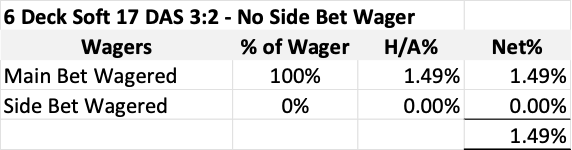
The following model shows a comprehensive tool for calculating the average mathematical advantage subject to the main wager and any subsequent side wagers for the common strategy player (H/A of 1.49%). This first example is for a Blackjack customer who does not wager on side bet. 100% of his wagered amount is on the main game of Blackjack.
In the second example we illustrate the effect on the mathematical advantage if the customer wagers 10% of his total betting amount on a Blackjack side bet which is subject to a house advantage of 5.0%. By conducting an observation of the player, or a group of players if you are looking for a common average, over a period of rounds you can determine what the money utilization percentage is. Whether they wager the side bet every hand or not, and the amount they wager, is not as important. It’s the total percentage of money they wager on each betting option during the period of observation that is important.
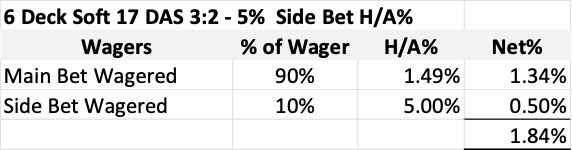
This following model shows the Blackjack customer wagering 90% of his or her money on the main Blackjack bet at 1.49%, and 10% the total money on the side bet at 5.0%. Please note that the calculated weighted “Net%” result of the H/A of the two wagers is 1.84%. Several commonly used Blackjack side bets are subject to an approximate house advantage such as Perfect Pairs, Lucky Lucky, and 21+3 (and variations).
Most side bets provide at a much higher H/A%. In the third example, the same percentage of wagering allotment will be used, but the H/A will be increased to 10.0%.
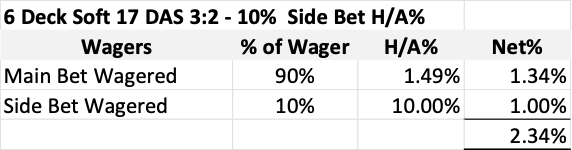
You will note that the high H/A% side bet has substantially increased the average mathematical advantage of the weighted “Net%” average wager to 2.34%.
Conclusion
It should be noted that the customer wagering on the main game of Blackjack is affected by the rules and number of decks. Using Basic Strategy as the baseline strategy, the six-deck Blackjack game, where the house opts to hit soft 17 and double after splitting, is subject to a theoretical return to the house of 0.69% of every dollar wager, or more simply stated, 69 cents for every $100 wagered on the main game.
However, only a small percentage of Blackjack customer utilize “perfect” Basic Strategy. Most rely on a variation known as “Common” strategy. Use of this strategy results in minor, but costly player errors that affect the mathematical edge. The common strategy will give back approximately 0.8% in player errors. By combining the mathematical house advantage created by the rules and number of decks used and the estimated cost of player errors of the “common” Blackjack player, the mathematical advantage increases to 1.34% or a theoretical win of $1.34 for every $100 wagered.
It should be noted that higher limit Blackjack customer’s play a better strategy and have a lower cost while novice players give back a larger portion of each bet due to uninformed and somewhat “gut” or hunch decisions.
Blackjack side bets are generally subject to a much higher mathematical edge as compared to the main game. Customers who never wager on side bets will not be affected. However, customers who frequently wager on side bets will be subject to a higher mathematical house advantage based on the percentage of total money wagered. Depending on the H/A% of the side bet, the average mathematical advantage on money wagered on the main bet and that wagered on the side bets could be subject to an H/A from 1.84% to 2.34%, or greater.
The above model can be used to calculate a more accurate mathematical advantage of your Blackjack customer’s theoretical win and will provide you with more accurate player ratings and better estimates to use for customer reinvestments.
Other Bill Zender and Associates articles on Blackjack Mathematical Advantage:
Shortcut For More Accurate Player Ratings In Blackjack – Bill Zender and Associates
-30-